
Pathology Board Review Question
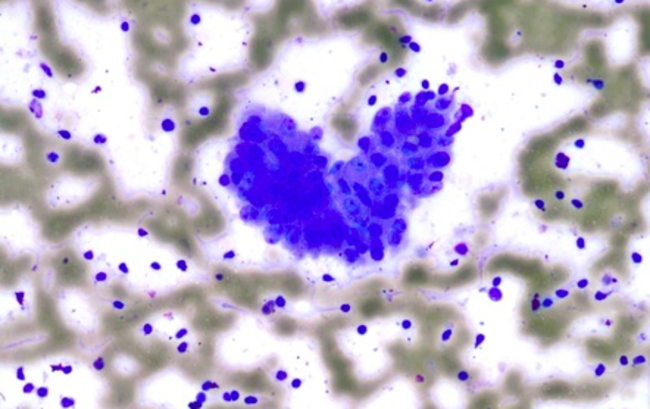
Which of the following diagnoses is most consistent with this representative image (below) demonstrating cytology obtained by fine-needle aspiration of a 6.3 cm parotid gland mass?
(A) Mucoepidermoid carcinoma
(B) Salivary duct carcinoma
(C) Pleomorphic adenoma
(D) Warthin tumor
(E) Papillary thyroid carcinoma
Answer & Explanation
Correct answer: (D) Warthin tumor
Warthin tumors are known for occurring in older patients, not infrequently show bilaterality and are associated with tobacco smoking. Features of Warthin tumor include a predominance of thin, watery mucoid material with monolayered sheets of oncocytic cells with distinct cell borders. Inflammatory cells with cellular debris are found in the background. A mixed population of lymphocytes is commonly seen.
Incorrect Answers:
(A) Features of low-grade mucoepidermoid carcinoma include clusters of cells with a gradual transition from intermediate to mature squamous-like epidermoid cells, with typically interspersed mucin-producing cells. The background shows mucinous debris. Chronic inflammation may be seen, but is not a dominant feature. These features are not seen in this specimen.
(B) Salivary duct carcinomas are typically high-grade and histologically mimics ductal carcinoma in situ (DCIS) of the breast. Cytology would show squamoid-appearing cells with background necrosis, and typically shows marked atypia. These features are not seen in these images.
(C) Features of pleomorphic adenoma include fibrillary and/or chondromyxoid stroma, myoepithelial cells (typically ovoid or plasmacytoid) which appear uniform, and uniformed epithelial cells forming ducts or small sheets. These features are not seen in the present specimen.
(E) Although a papillary configuration is seen, the nuclear features of papillary thyroid carcinoma are not seen on the representative image shown.